Preptober: Plan Your November Novel in Four Weeks
If you’re writing a novel in November, October is your secret weapon. Thousands of writers spend November racing to 50,000 words, and the ones who get there usually have one thing in common: they planned in October. Writers call it Preptober.
You don’t need to outline every scene. You need enough of a map that you never sit down on a writing day wondering what happens next. Here’s a simple four-week plan that gets you there, one week at a time.
Week 1: Know what your story is about
Start with the premise in one or two sentences: who wants what, and what stands in their way. If you can’t say it simply yet, that’s your first job this week.
Then get to know your main characters. For each one, jot down:
- What they want at the start of the book
- What they actually need (often not the same thing)
- What they’re afraid of
- How they’ve changed by the end
Keep it rough. A few lines per character is plenty. You’ll learn more about them once you start writing.
Week 2: Find the shape of the story
Now zoom out. Whatever structure you prefer, most stories hang on a handful of big moments:
- The opening, where we meet your character in their normal world
- The inciting incident that knocks that world off balance
- The point of no return, where they commit to the journey
- The midpoint, where something shifts and the stakes rise
- The lowest point, when all seems lost
- The climax and the ending
If you know roughly where these land, you have a spine to hang everything else on. Knowing your ending matters most. It’s much easier to write towards something.
Week 3: Lay out your scenes on a timeline
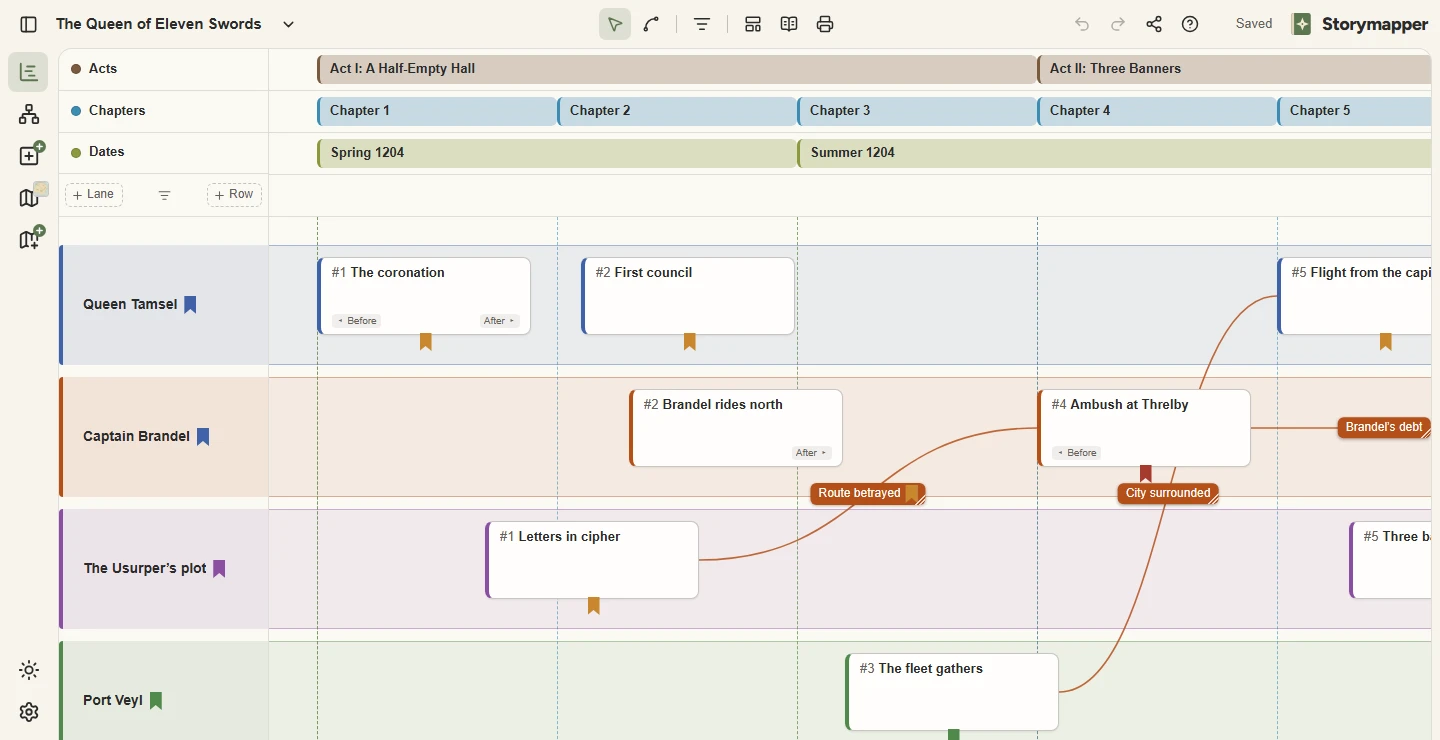
This is where the plan becomes something you can write from. Break each section of your story into scenes, with a line or two for each: who’s in it, what happens, and what changes.
Then put them in order on a timeline. Seeing the whole book laid out at once shows you things a list never will:
- Gaps where nothing happens for too long
- Characters who vanish for half the book
- Subplots that start and never resolve
- Events that couldn’t happen in the order you’ve written them
If you’re writing multiple storylines, give each its own row so you can see how they weave together. Aim for 40 to 60 scenes for a typical novel, but don’t worry if yours is different.
Week 4: Get ready to write
The last week is about clearing the way. Work out when you’ll write each day and how many words you need per session. For 50,000 words in November, that’s about 1,667 a day.
Pick the first few scenes you’ll write so that 1 November isn’t a blank page. Then stop planning. Your outline is a map, not a contract. If a character surprises you in week two of November, follow them and adjust the map later.
Where your plan lives
For years I planned my stories in an Excel spreadsheet, colouring cells like a Gantt chart to track scenes and storylines. It worked, but it was fiddly. So I built Storymapper: a simple web tool for laying out your story on a timeline, with a row for each storyline.
Storymapper is built for the structural part of the plan, weeks 2 and 3: mapping out your big turning points and laying every scene on a timeline. It’s free to sign up, so if you’re doing Preptober this year, give it a try. Whatever you use, I hope your November goes brilliantly.